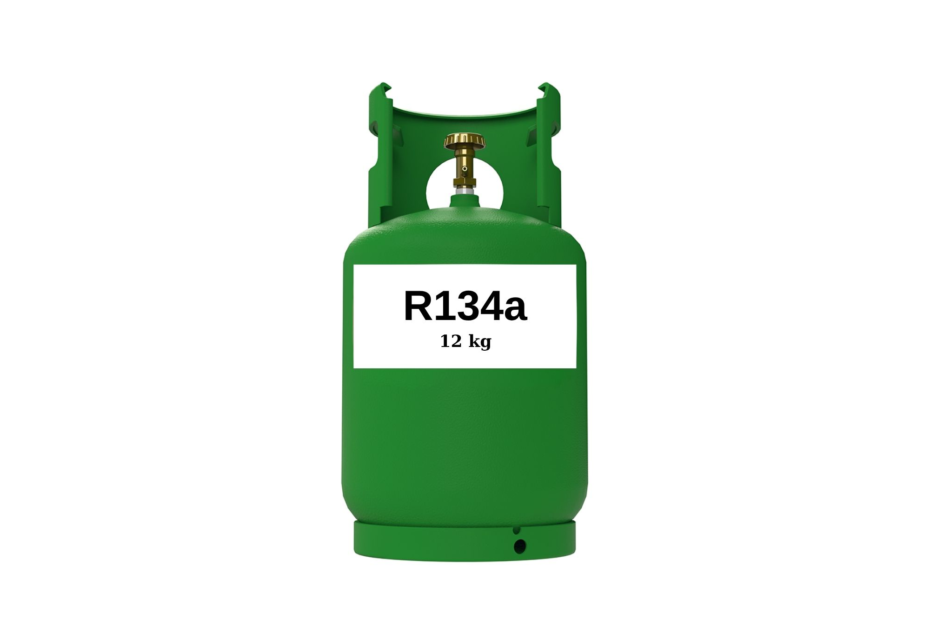
R134a (1,1,1,2-Tetrafluoroethane) is a hydrofluorocarbon (HFC) refrigerant with the chemical formula CH2FCF3.
It was developed as a non-ozone-depleting replacement for R12 (CFC) and has become one of the most widely used refrigerants in the world for medium-to-high temperature cooling applications.
General Characteristics
- Environmental Profile: It has an Ozone Depletion Potential (ODP) of 0. Its Global Warming Potential (GWP) is 1430.
- Safety Classification: Rated as A1 by ASHRAE, meaning it is non-toxic and non-flammable under normal operating conditions.
- Stability: As a single-component refrigerant, it has Zero Temperature Glide. This makes it easy to handle, as the composition does not change during leakage or recharging.
- Lubrication: It is not compatible with traditional mineral oils. It requires synthetic lubricants, typically POE (Polyolester) for stationary systems and PAG (Polyalkylene Glycol) for automotive air conditioning.
- Physical Nature: It is a colorless gas with a slight ethereal odor.
Technical Specifications
| Property | Value |
| Chemical Name | 1,1,1,2-Tetrafluoroethane |
| Molecular Weight | 102.03 g/mol |
| Boiling Point (at 1 atm) | -26.3 °C (-15.34 °F) |
| Critical Temperature | 101.1 °C (213.98 °F) |
| Critical Pressure | 40.6 bar (588.9 psia) |
| Liquid Density (at 25°C) | 1206 kg/m³ |
| Vapor Pressure (at 25°C) | 6.65 bar (96.5 psia) |
| Safety Group | A1 |
Typical Applications
- Automotive: The standard refrigerant for mobile air conditioning (MAC) systems in older and many current vehicles.
- Domestic Appliances: Used in household refrigerators, freezers, and water dispensers.
- Commercial/Industrial: Used in large centrifugal chillers, commercial refrigeration units, and transport refrigeration.
- Aerosols: Also utilized as a propellant for medical inhalers and specialized cleaning sprays.